
Hillsdale
a review of a play by Roman D'ambrosio

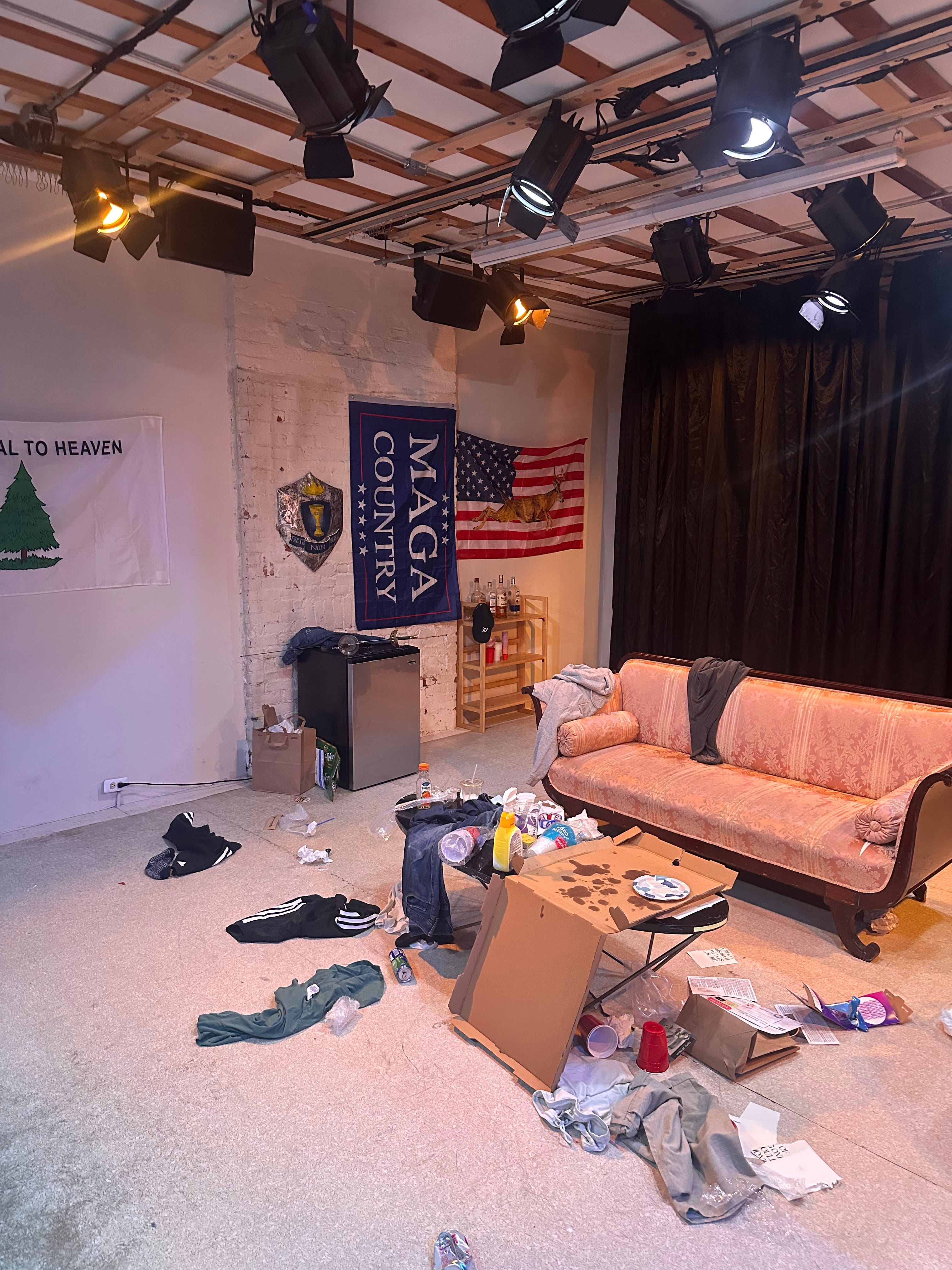
Hillsdale opens in the disgusting mess of a frat house, where multiple parties over several years have ended but never once been cleaned up. Crushed beer cans, stale food, relics of a life that has technically ended but refuses to disappear. The motto still hangs on the wall, Facta Non Verba, deeds not words, but nothing here resembles action anymore.
Michael is already on stage when the play begins. Long stingy hair, beer in hand, moving through the wreckage like a pig in a pen. Not a man living in filth so much as someone who has ceased to perceive it. Soon Bruno enters, trash bag in hand, trying in vain to tidy up. An important guest is coming. The house must be made presentable, if only as a performance. Michael couldn’t care less. “It’s the end of history for us,” he says, fukuyama-esque.
The party is over in a very literal sense. These men never left the frat house after graduation. They have lingered in the ruins of a hierarchy that no longer exists. The guest of honor is Reese, former president of the fraternity, now successful, married, and, crucially, the one whose family money still effectively controls the house. Ownership here is murky in legal terms, but psychologically absolute. Reese’s visit is more like a sovereign visiting his subjects than a friend dropping by.
He arrives with his wife Marina and his sister Zoey, and immediately the contrast is unbearable. Reese is composed, articulate, full of ideological language and institutional affiliation. He works with the Cato Institute, speaks in the idiom of Austrian economics and civilizational decline, and carries himself like a man who believes he himself can shape history. “A modern Ayn Rand,” one character remarks. Atlis shrugs, leaving Reese to do the heavy lifting.
But the play is not naïve about him. His intellectualism is both sincere and hollow. He delivers long, quasi-philosophical monologues about death, legacy, and how future generations will misread us, arriving finally at a kind of cosmic apathy, an argument that nothing we do will matter, and therefore perhaps nothing should.
It’s dressed up as depth, but it’s really a coping mechanism.
Around him, the class structure of the play becomes unavoidable. Zoey sells shoes at Macy’s, saddled with debt and drifting. Bruno works with his hands, barely holding the house together. Michael scrapes by doing landscaping, living season to season. Reese alone moves through institutions, capital, and abstraction with ease. The old fraternity brotherhood, the supposed equality of the frat, is revealed as a fiction that only ever masked these differences.
The play’s real subject is not simply “post-college malaise.” It’s downward mobility, or more precisely, the dawning realization that mobility was never equally available to begin with.
What makes Hillsdale more than a sociological sketch is how it binds this class tension to desire. Everyone wants something from someone they cannot have. Michael wants Marina, but more than that he wants what she represents: a life he believes was stolen from him. Marina, for her part, is not simply a gold-digger caricature; she is fully aware of the Faustian bargain she has made, and fully trapped within it. Bruno and Zoey circle each other in a different register, physical, tentative, almost innocent, but equally doomed.
These relationships feel unsolvable not because of bad timing or miscommunication, but because the underlying structures (money, status, history) make resolution impossible. Love doesn’t fail here. It never really had a chance.
The play keeps returning, in different forms, to a single question: who is the real failure?
Michael, who sees through everything and therefore can do nothing? Cigarette hanging out of his mouth. Bruno, who works, endures, and shrinks his ambitions to fit reality? Reese, who has “won” but cannot stop performing his own importance? Marina, who trades freedom for security and resents both? Zoey, who was promised a future in education and instead inherits debt and invisibility as a shoe saleswoman?
No one escapes. Each represents a different adaptation to the same underlying condition: a world in which the scripts that once structured meaning—college, brotherhood, upward mobility—no longer function.
Even the fraternity itself reads as a kind of failed aristocracy. It promised lifelong bonds, hierarchy, and honor, but offered none of that, leaving behind only symbols and debts.
“Deeds not words” becomes, in retrospect, a cruel joke.
What’s striking is that the characters are not deluded about this. They are painfully self-aware. Reese admits, in private, that he feels like a “husk.” Michael knows his resentment is consuming him. Bruno understands he has settled. Zoey can articulate her own failure in almost clinical terms. There is no illusion to puncture. Only the question of what one does after the illusion is gone.
That’s where the play edges into something closer to philosophy. If Michael is right, if this really is the “end of history” for them, then the problem is not how to succeed, but how to live without the possibility of meaningful change. Reese answers with ideology. Bruno with work. Zoey with longing. Michael with rage. None of them quite succeed.
The result is a kind of American Chekhov: characters who talk, remember, desire, and fail to move, not because they lack will, but because the world they inhabit no longer converts will into outcome.
By the end, what lingers isn’t a single tragedy but a shared condition. These are not exceptional people. They are typical. That’s what makes it unsettling.
Hillsdale is, at its core, a play about what happens after the promise breaks, when you are left not with catastrophe, but with the slow, humiliating realization that nothing is coming to save you, and nothing you were told to do was ever quite enough.
Nice reading! I enjoyed the recap and perspective. You were quick to post that.
Spot on. Some great insights there. The setting of the fraternity house as a decayed hierarchy made it feel very subversive to me when I first saw it. I had never seen that particular setting presented as a ruin. And I love what you said about it "masking the class differences" in the past. There's a lot of despair in this play in the best, provocative way.