
A Return to Arden

As You Like It is one of Shakespeare’s pastoral comedies. The play takes place in the Forest of Arden, where Rosalind, surely one of Shakespeare’s most brilliant and witty characters, up there with Sir John Falstaff, has fled after being banished from court. Disguised as a young man, she wanders the forest with her cousin Celia. Two nobles undercover as provincials.
Meanwhile, Orlando, though noble by birth, has been mistreated by his older brother, who has denied him the education and upbringing due to a gentleman. At one point Orlando bitterly asks what “prodigal portion” he has ever squandered that he should be reduced to such a condition. “My brother Jaques he keeps at school, and report speaks goldenly of his profit; for my part he keeps me rustically at home…He lets me feed with his hinds, bars me the place of a brother, and…mines my gentility with my education.” He is, in a sense, a gentleman rusticated by his own brother.
Without getting into a full synopsis, which isn’t the point of this essay, both Rosalind and Orlando find themselves displaced into Arden. Rosalind arrives carrying the sophistication of the court into the countryside. Orlando arrives as someone whose natural nobility has survived in name but evacuated of most of the privileges that should accompany it. The forest becomes a place where both are able to become different versions of themselves.
I think about where I grew up as a kind of Forest of Arden.
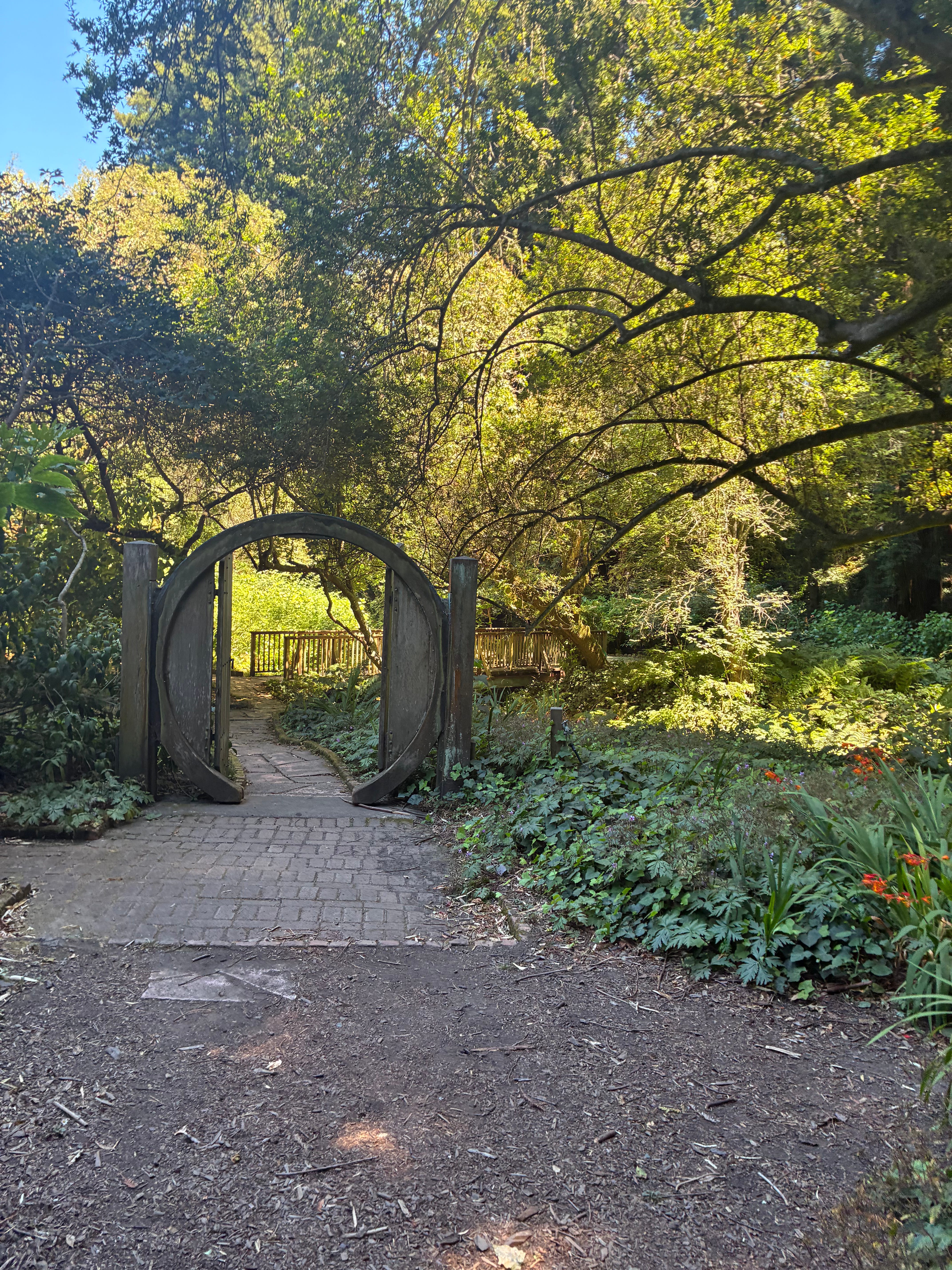
In front of our house stood a large redwood grove, Stolte Grove, really three groves flowing into one another, thought beautiful redwood lined trails. One had a stage where symphonies would occasionally perform, or weddings would happen. If I ever get married, I want it to be there, on that stage. In another there was a small bench where, during high school, I sat reading As You Like It. I learned huge portions of the play almost line by line, pacing around my own little Arden.
I identified with parts of both Rosalind and Orlando.
We lived in Mill Valley, part of Marin County, fifteen minutes north of San Francisco and hardly the wilderness. But my mother was from San Francisco—the City—and my grandparents still lived there. My father was from the west side of 44th Street in Manhattan. Both of them were city people.
My mother fit naturally into Marin. Growing up in San Francisco in the 1960s, it had been her dream to live in Mill Valley and be surrounded by redwoods. My father loved it too, but he was less obviously at home there. He had a strong New York accent and always seemed, at least to me, slightly displaced in our little Arden.
He was very much in love with my mother, as Orlando was Rosalind, though in the flawed, imperfect, and entirely human way real people are. I remember him once consulting me and my sister before picking her up from the airport, asking whether his hair looked good before applying a generous amount of what he called “smell swell,” his term for cologne.
My mother, despite loving Marin’s beauty, remained a city girl. She carried herself with a cosmopolitan air. Haircuts, for example, were activities that had to happen in the city. The provincials of fancy Marin County, apparently, could not be trusted with contemporary fashion. You would think we were living in the sticks.
Some of that attitude rubbed off on me, I’m somewhat embarrassed to admit.
I loved where I grew up. I loved the redwoods and the fog and the landscape. I feel like that geography is a part of who I am and you can’t understand me if you don’t understand it, understand the topography of my childhood. But for as long as I can remember I wanted to leave. I wanted to go to the Big City. The Big City, of course, was New York, not San Francisco. Like Pip in Great Expectations, I wanted to become a gentleman. I wanted to meet artists, writers, thinkers, have interesting conversations in late-night bars. I had a voracious hunger to become cosmopolitan, to become, like Pip, a gentleman.
So I moved to New York at twenty-one.
And I can safely say that, to some degree, I achieved what I set out to do. I’m a New Yorker now. Not merely because I’ve lived here for years, or because I was born here (which I was), but because I’ve internalized a certain way of paying attention. I know what exhibitions are opening, what books people are reading, what arguments are circulating. I guess you could say I’m plugged into “the discourse.”
But lately I can’t shake the feeling that I solved the wrong problem.
For most of my life I thought the story was about escaping Arden and making my way to court. About leaving the provinces, acquiring sophistication, and becoming worldly.
Now I find myself longing for Arden.
Not the Arden of childhood. You don’t get to go back to that one. But another version of it: a slower life, a wife, a family, a grove of redwoods outside the window. All the conventional things my younger self was certain he didn’t want.
The irony is that I spent half my life trying to leave the forest only to discover that Shakespeare’s exiles were all better off there.